Iron Condor: A Limited-Risk Strategy That Bets on a Trading Range
Learn how an iron condor works, how max profit and max loss are defined, and why the strategy depends on range stability, time decay, and volatility.
An iron condor is a defined-risk options strategy built from:
- a short out-of-the-money put spread
- a short out-of-the-money call spread
Together, those four options create a trade that usually profits most when the underlying asset stays in a relatively stable range until expiration.
How the Strategy Is Built
A standard short iron condor is usually set up as:
- buy a lower-strike put
- sell a higher-strike put
- sell a lower-strike call
- buy a higher-strike call
The short put and short call are the inner strikes. The long options are the wings that cap risk.
Because the trader usually receives a net credit up front, the position is often described as a range-bound premium-selling strategy.
What the Trader Is Really Betting On
The trader is usually betting that:
- the underlying asset will remain between the short strikes
- time decay will erode the sold options
- implied volatility will not expand in a way that makes the position more expensive
This is why an iron condor is often attractive in quiet or range-bound markets and much more dangerous in markets prone to violent breakouts.
Payoff at Expiration
The payoff profile makes the strategy easier to read: the flat middle zone shows where the trade earns maximum profit, the breakevens mark the edges of the profitable range, and the wings cap loss on both sides.
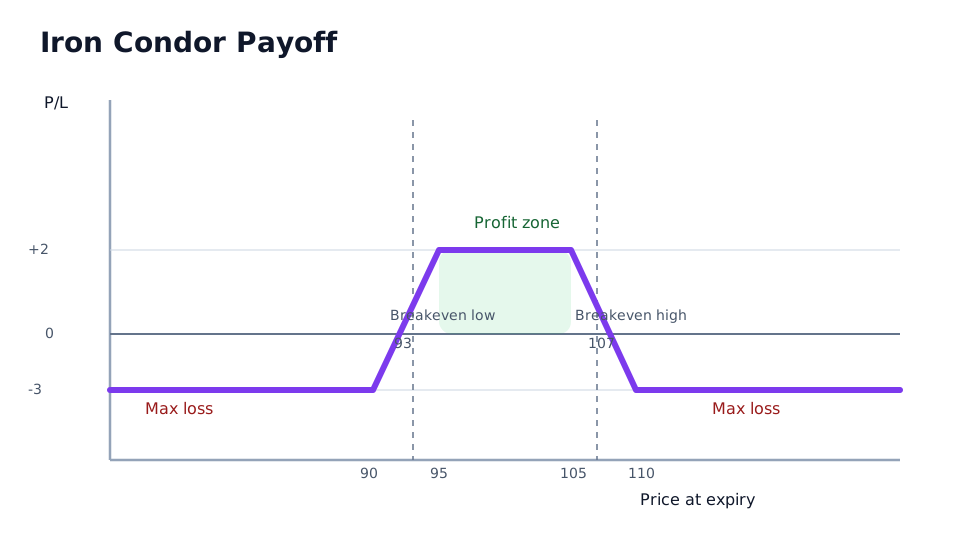
Max Profit, Max Loss, and Breakevens
If the condor is opened for a net credit:
- maximum profit = net credit received
- maximum loss = wing width minus net credit
Breakevens at expiration are:
That means the position can still be profitable even if the underlying asset moves somewhat, as long as it stays inside the breakeven range.
Worked Example
Suppose a stock is trading at $100 and a trader opens this iron condor:
- buy 90 put
- sell 95 put
- sell 105 call
- buy 110 call
- net credit received =
$2
Then:
- max profit =
$2 - max loss =
$5 - $2 = $3 - lower breakeven =
$93 - upper breakeven =
$107
The trade works best if the stock stays near the center of the range and expires between $95 and $105.
Why Traders Misunderstand Iron Condors
Many traders see the high probability profile and assume the strategy is “easy income.”
That is a mistake.
An iron condor can still lose meaningfully when:
- the underlying asset breaks out of the range
- volatility expands after entry
- the position is opened too close to a major event
- liquidity or assignment risk complicates adjustments
Defined risk does not mean trivial risk.
Related Terms
- Bull Put Spread: One half of the iron condor structure.
- Bear Call Spread: The other half of the structure.
- Credit Spread: The income profile created by receiving premium up front.
- Implied Volatility: A major driver of entry pricing and risk.
- Theta: Time decay often supports the strategy when the market stays calm.