Compound Interest: How Money Earns Returns on Prior Returns
Learn how compound interest works, why time matters so much, and how compounding affects savings, investing, and borrowing costs.
Compound interest means interest is earned not only on the original principal, but also on interest that was earned in earlier periods. That is why compounding creates curved, accelerating growth instead of straight-line growth.
It is one of the most powerful ideas in personal finance and investing. It helps savers build wealth over long periods, and it also explains why debt can become expensive when balances are not paid down quickly.
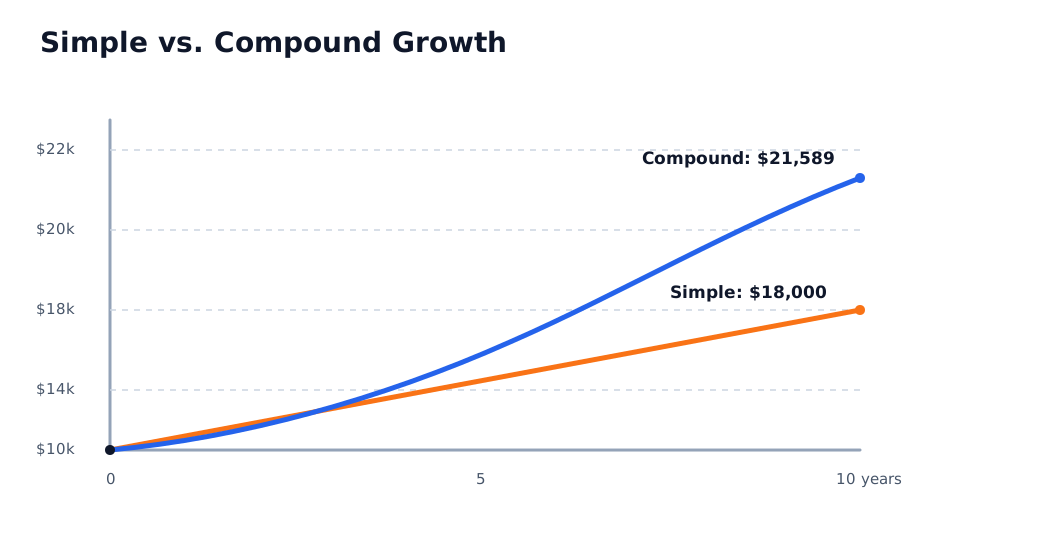
Compound growth bends upward because each year’s gains become part of the base for future gains.
Why Compound Interest Matters
Two variables make compounding powerful:
-
the rate you earn or pay
-
the time money spends compounding
The second factor is often underestimated. A modest rate applied over a long period can produce remarkable growth, while a high rate applied for only a short period may not.
That is why investors care so much about starting early.
Compound Interest Formula
For periodic compounding:
Where:
-
\(A\) = ending amount
-
\(P\) = initial principal
-
\(r\) = annual interest rate
-
\(m\) = number of compounding periods per year
-
\(t\) = number of years
If interest compounds annually, \(m = 1\). If it compounds monthly, \(m = 12\).
Compound Interest vs. Simple Interest
With simple interest, interest is calculated only on the original principal.
With compound interest, each period’s interest becomes part of the base for future interest calculations.
That difference looks small early on, but it widens over time.
Worked Example
Suppose you invest $10,000 at 8% for 10 years.
If interest is simple
You earn:
If interest compounds annually
If interest compounds monthly
The annual-versus-monthly difference is real, but the biggest driver is still the fact that the money was allowed to compound for a full decade.
Why Time Usually Matters More Than Frequency
People often fixate on whether interest compounds monthly, daily, or continuously. That matters, but less than many think.
The larger driver is usually:
-
how long the money stays invested
-
whether earnings are reinvested
-
whether new contributions are added consistently
Starting earlier usually beats trying to make up for lost time later with a slightly better rate.
Savings and investing
Compound growth helps retirement accounts, brokerage accounts, and reinvested dividends grow over long periods.
Borrowing
Credit card balances and unpaid loans can also compound, which is why high-rate debt can snowball quickly.
APY and quoted returns
The difference between APR and APY exists largely because of compounding.
Confusing APR with actual earned yield
APR may not include compounding effects, while APY does.
Ignoring the cost side of compounding
People celebrate compounding when investing, but the same mechanism works against borrowers with revolving debt.
Underestimating time
Many investors focus on chasing a slightly higher return when the larger improvement may come from starting sooner and staying invested longer.
Related Terms
-
Time Value of Money: The broader principle behind compounding and discounting.
-
Future Value: The amount a present sum grows to after compounding.
-
Simple Interest: Interest calculated only on the original principal.
-
Annual Percentage Yield (APY): The effective annual return after compounding.
-
Annuity: A stream of repeated contributions or payments over time.