Browse Investing
-
-
-
-
-
-
-
-
-
-
-
- Chartered Governance Professional
- ESRS
- Ethical Investing
- Green Chip Stocks Overview
- Green Fund: Comprehensive Guide
- IIRC
- Investing in Water
- Morningstar Sustainability Rating
- MSCI
- New Paradigm in Investing
- Social Audit
- Socially Conscious Investments
- Socially Responsible Investment
- Stewardship Code
- TCFD
- UN Principles for Responsible Investment (PRI)
Bond: A Loan From an Investor to an Issuer
Learn what a bond is, how coupon payments, price, yield, and maturity work, and why bond prices move opposite to interest rates.
A bond is a debt security. When you buy a bond, you are effectively lending money to an issuer such as a government, municipality, or corporation. In return, the issuer promises to make scheduled interest payments and repay principal at maturity.
That makes a bond different from a stock. A stock gives ownership. A bond is a contractual claim on cash payments.
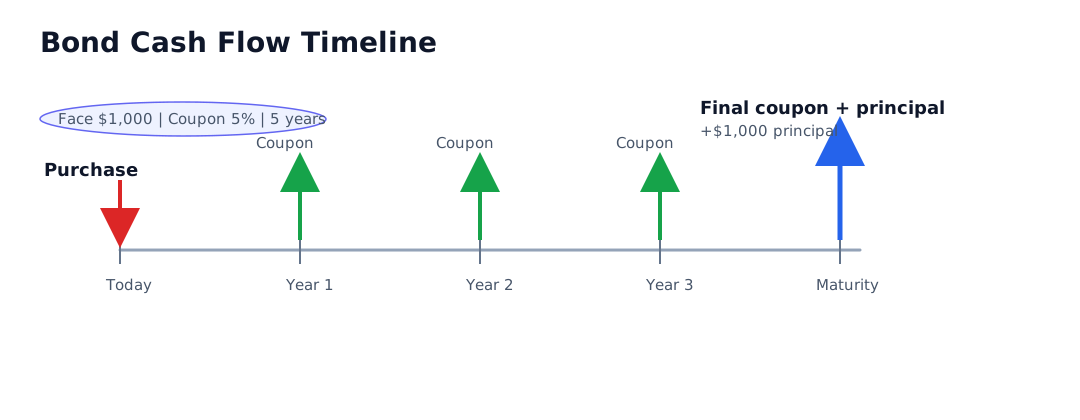
A plain-vanilla bond is a timeline of cash flows: purchase now, coupons during the life of the bond, and principal back at maturity.
The Key Parts of a Bond
Most plain-vanilla bonds can be understood through five pieces:
- issuer: the borrower
- face value or par value: the amount repaid at maturity
- coupon rate: the stated interest rate on face value
- coupon payment: the actual periodic cash payment
- maturity date: the date principal is repaid
Example: a bond with $1,000 face value and a 5% annual coupon pays $50 per year if coupons are annual.
How Bond Pricing Works
A bond’s price is the present value of:
- all remaining coupon payments
- the face value repaid at maturity
Where:
- \(P\) = bond price
- \(C\) = coupon payment
- \(r\) = market yield
- \(F\) = face value
- \(n\) = number of remaining periods
Why Bond Prices and Yields Move in Opposite Directions
This is the most important bond intuition.
If new bonds in the market start offering higher yields, an older bond with a lower coupon becomes less attractive, so its price falls. If market yields fall, an older bond with a higher coupon becomes more attractive, so its price rises.
That inverse relationship is foundational to fixed-income investing.
Premium, Discount, and Par Bonds
- A bond trading at par sells near face value.
- A bond trading at a premium sells above face value.
- A bond trading at a discount sells below face value.
These positions are closely connected to yield to maturity (YTM).
- premium bond: coupon rate is usually above market yield
- discount bond: coupon rate is usually below market yield
- par bond: coupon rate is usually close to market yield
Worked Example
Suppose you own a 10-year bond with:
- face value of
$1,000 - coupon rate of 5%
- annual coupon payments
If market yields fall from 5% to 4%, new bonds are less generous than yours. Investors will usually pay more than $1,000 for your bond.
If market yields rise from 5% to 6%, your bond becomes less attractive relative to new issues, so its price will usually fall below $1,000.
Main Types of Bonds
Common bond categories include:
Each type changes the risk and cash-flow pattern, but the basic pricing logic stays the same.
How Investors Buy Bonds
Investors can access bonds in a few ways:
- buying individual bonds directly through a broker or new issue
- buying bond mutual funds
- buying bond exchange-traded funds (ETFs)
Individual bonds give direct exposure to one issuer and maturity date. Bond funds trade some of that control for diversification and convenience.
Bonds Compared With Other Investments
- Stocks vs. bonds: stocks represent ownership, while bonds represent a creditor relationship.
- Savings accounts vs. bonds: savings accounts are usually more liquid and safer, but bonds often offer higher potential income.
That comparison helps explain why bonds are often used for income and stability rather than maximum growth.
How Investors Buy Bonds
Investors can access bonds in a few ways:
- buying individual bonds directly through a broker or primary issue
- buying bond mutual funds
- buying bond exchange-traded funds (ETFs)
Individual bonds give direct exposure to one issuer and maturity date. Bond funds trade some of that control for diversification and convenience.
Bonds Compared With Other Investments
- Stocks vs. bonds: stocks represent ownership, while bonds represent a creditor relationship.
- Savings accounts vs. bonds: savings accounts are usually more liquid and safer, but bonds often offer higher potential income.
That comparison helps explain why bonds are often used for income and stability rather than maximum growth.
Interest-rate risk
Bond prices can fall when yields rise.
Credit risk
The issuer may fail to make promised payments.
Inflation risk
Fixed coupon payments may lose purchasing power if inflation rises.
Reinvestment risk
Coupon payments may have to be reinvested at lower rates than expected.
Confusing coupon rate with total return
A bond’s coupon tells you its stated interest payment, not necessarily the return you will earn at the price you paid.
Assuming all bonds are equally safe
Government bonds, investment-grade corporate bonds, and high-yield bonds can have very different credit risk.
Ignoring duration
Longer-duration bonds are generally more sensitive to interest-rate changes.
Related Terms
- Coupon Rate: The stated annual interest rate on face value.
- Yield to Maturity (YTM): The bond’s market-implied hold-to-maturity return.
- Par Value: The principal amount repaid at maturity.
- Duration: A key measure of interest-rate sensitivity.
- Credit Spread: The extra yield investors demand for credit risk.