Browse Investing
-
-
-
-
-
-
-
-
-
-
-
- Chartered Governance Professional
- ESRS
- Ethical Investing
- Green Chip Stocks Overview
- Green Fund: Comprehensive Guide
- IIRC
- Investing in Water
- Morningstar Sustainability Rating
- MSCI
- New Paradigm in Investing
- Social Audit
- Socially Conscious Investments
- Socially Responsible Investment
- Stewardship Code
- TCFD
- UN Principles for Responsible Investment (PRI)
Risk-Return Tradeoff: Why Higher Expected Return Usually Requires More Risk
Understand the risk-return tradeoff, why it exists, and how investors use it when building portfolios and setting return expectations.
The risk-return tradeoff is the basic investing principle that higher expected return usually requires accepting more risk. Investors who want a chance at higher gains generally need to tolerate more uncertainty, more volatility, or a greater probability of loss.
At a practical level, this idea helps explain why Treasury bills offer lower expected return than stocks, why speculative assets need a higher expected payoff to attract capital, and why portfolio design is always a balance rather than a free lunch.
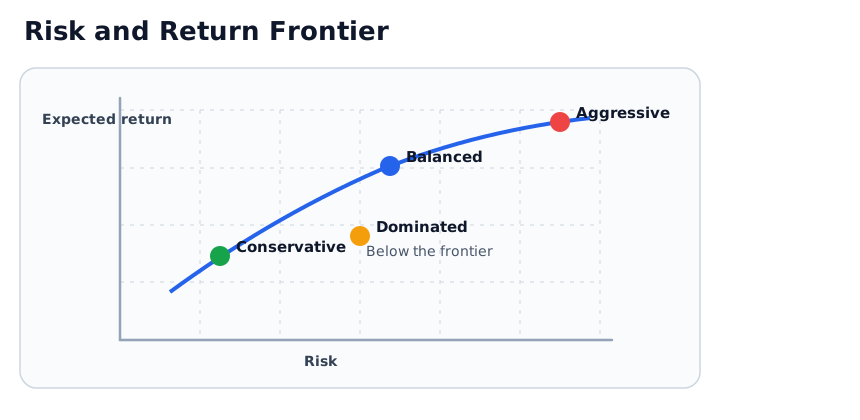
The core idea is not that every risky investment pays more. It is that, all else equal, investors demand higher expected return when they must bear more risk.
Why the Tradeoff Exists
Risk matters because future outcomes are uncertain. Investors part with capital today in exchange for future cash flows that may not arrive exactly as expected.
When uncertainty rises, investors usually want compensation. That compensation can take many forms:
- higher expected return
- lower purchase price
- stronger covenants
- more upside potential
If an investment offers more risk with no extra expected reward, rational investors will usually prefer a safer alternative.
Risk Does Not Guarantee Return
The principle is often misunderstood.
The risk-return tradeoff does not say that risky investments always outperform. It says that investors usually require higher expected return to justify taking more risk.
That leaves room for bad outcomes. A high-risk asset can still lose money. In fact, that possibility is part of what makes the expected return need to be higher in the first place.
Common Ways Risk Is Measured
Different investors mean different things by “risk.” Common measures include:
- Standard Deviation for volatility
- downside risk and drawdown
- default probability
- liquidity risk
- concentration risk
That is why portfolio construction is not just about maximizing return. It is about choosing the type and amount of risk the investor can actually live with.
Real-World Portfolio Example
Suppose an investor compares three portfolios:
- a conservative bond-heavy mix
- a balanced stock-bond mix
- an equity-heavy aggressive mix
The aggressive version may have the highest expected return, but it also has the greatest exposure to market swings. During a severe drawdown, the investor may be forced to sell at the wrong time unless the portfolio matches the investor’s horizon and risk tolerance.
So the right portfolio is not simply the one with the highest expected return. It is the one whose risk-return profile fits the investor’s goals and constraints.
How Investors Use the Tradeoff
The risk-return tradeoff sits behind:
- Asset Allocation
- Efficient Frontier thinking
- performance evaluation
- capital budgeting and required return
It also helps explain why risk-adjusted metrics such as the Sharpe Ratio matter. Raw return alone is not enough.
Chasing return without understanding the risk
Many investors focus on recent performance and ignore how fragile that performance may be.
Taking risk you cannot hold through
A portfolio may look optimal on paper but fail in real life if the investor cannot tolerate its losses.
Assuming all risk is rewarded equally
Some risks are avoidable or poorly compensated. Good investing is not about maximizing any risk. It is about choosing compensated risk intentionally.
Related Terms
- Expected Return: The return investors hope to earn before the uncertainty is resolved.
- Standard Deviation: A common measure of portfolio volatility.
- Sharpe Ratio: Compares excess return with total volatility.
- Asset Allocation: The main way investors choose their overall risk posture.
- Diversification: Helps improve the return received for the risk taken.